Tree root intrusion in sewer lines is a fairly common problem and can be extremely damaging if left unchecked or not handled properly. This is especially the case for commercial and municipal sewer systems that carry a larger volume of wastewater and need to always function properly. We’ll explain everything that commercial property and municipal facility managers should know about tree root intrusion in sewer systems and what options exist for eliminating the problem.
How Tree Roots Enter and Damage Sewer Infrastructure
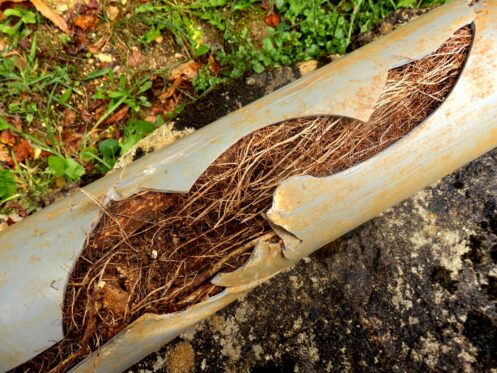
Tree roots continuously grow and spread out in search of water and nutrients, and the wastewater that flows through sewer lines provides them with everything they’re seeking. Intrusion typically starts with tiny roots getting inside through a gap in a pipe fitting or a crack. The water and waste then nourish the roots, causing them to quickly start growing much bigger and starting to completely take over the pipe. As the roots grow, they can do major damage, such as putting a large hole in the pipe or causing it to break. Larger roots can also exert enough force on a pipe to break or punch a hole in it.
Another concern is that waste, toilet paper and other solid materials get trapped in the roots, resulting in a blockage that can quickly lead to a major clog. Not only does the clog prevent wastewater from draining, but there’s also a risk that the pipe will break or rupture.
Early Warning Signs of Root Intrusion in Commercial and Municipal Systems
The biggest risk of root intrusion is the sewer line clogging and backing up. In a commercial sewer system, you’ll usually notice some warning signs that indicate the main line is starting to become obstructed and at risk of backing up. This includes sewage odors near plumbing fixtures, all the drains in the building being slow and toilets gurgling or not flushing completely. If the roots have damaged the line to the point that it’s leaking, you’ll often smell sewage outside when standing near where the line runs underground.
Municipal sewer systems often use sensors to measure the flow rate in the mains. In this case, the biggest clue that roots are growing in a main is a steady drop in the flow rate over time.
Hydro Jetting vs. Mechanical Root Cutting: What Works Better?
Hydro jetting and mechanical root cutting can both be used to clear tree roots out of a sewer line. However, it depends on how large the roots are and how extensive the problem is. Hydro jetting uses high-pressure water jets to blast away debris and fully clean the sides of the pipe. It’s a great solution for eliminating issues caused by grease, scale and sludge buildup. The water jets are powerful enough that they can cut through and wash away smaller roots, but hydro jetting is less effective at tackling larger masses of roots.
Mechanical root cutting involves inserting a cable with a rotating cutting blade through the sewer line. The blade is sharp enough and spins with enough force that it can slice straight through much larger roots. The blade expands so that it touches the sides of the pipe, allowing it to fully cut out the entire root mass. It also cleans the inside of the pipe, but not nearly as well as hydro jetting does.
When Root Intrusion Requires Pipe Repair or Replacement
If the roots are getting in through a single small gap in a pipe fitting, you don’t necessarily need to repair or replace the sewer line. Hydro jetting or mechanical cutting will get rid of the roots so that the pipe drains properly again, but you can pretty much be certain that the roots will return and start causing issues within a year or two. Nonetheless, yearly sewer cleaning can help you avoid a major sewer repair in this type of situation.
If larger roots have damaged the pipe, the only way to avoid constant issues is sewer repair or replacement. Smaller holes and cracks can often be repaired through a process known as trenchless pipe lining. If there’s extensive damage, the only option is to replace the pipe. Luckily, this can sometimes be done without needing to excavate the pipe.
Preventing Future Root Growth in Sewer and Storm Systems
At Reddi Services Industries, we have decades of experience overcoming and preventing root issues in commercial and municipal sewer and storm systems. We offer CCTV pipe inspections that can identify root intrusion or any other problems. We also specialize in a wide range of other commercial services, including grease trap cleaning and maintenance, liquid waste removal, tank cleaning and dry well maintenance.
To schedule a sewer repair or an on-site consultation in Kansas City, contact Reddi Services Industries today.